What Affects the Cost of Laser Welding?
Introduction and Article Outline: Why Laser Welding Cost Deserves a Closer Look
Laser welding can look like a simple bright line of light, yet its price is shaped by a wide mix of equipment, labor, materials, quality demands, and production speed. For a shop owner, engineer, or buyer, understanding those variables is the difference between a realistic quote and an expensive surprise. This article explains the main cost drivers, compares laser welding with other joining methods, and shows where the process can reduce total manufacturing expense over time.
At first glance, people often ask one direct question: “How much does laser welding cost?” The honest answer is that there is no single number that fits every job. A handheld repair on thin stainless steel, an automated battery-pack seam, and a precision medical assembly may all use laser energy, but they sit in very different cost worlds. One is priced like a skilled service, another like a capital project, and the third like a highly controlled manufacturing operation. The beam may be the star of the show, yet the supporting cast matters just as much: fixtures, safety systems, programming, part tolerances, throughput targets, and inspection requirements all take a bow before the final invoice appears.
To make the topic easier to follow, this article is organized into five parts. The outline below serves as a road map before we move into the details.
- How laser welding costs are structured and why the topic matters
- Equipment, installation, and setup expenses that drive capital cost
- Operating and job-based pricing factors such as labor, material, speed, and quality control
- A comparison of laser welding with TIG, MIG, and resistance welding from a cost perspective
- A practical conclusion for buyers, estimators, and production managers choosing the right process
The relevance of this subject keeps growing because manufacturers are under pressure to do several difficult things at once: improve quality, shorten lead times, control labor expenses, and reduce rework. Laser welding can support those goals, especially where precision, repeatability, or low distortion matter. At the same time, it can be the wrong economic choice for parts with loose fit-up, highly reflective materials without proper process control, or applications where a conventional method already delivers acceptable quality at lower capital cost. That tension is what makes cost analysis important. A smart decision is rarely about the cheapest machine or the lowest hourly quote. It is about matching the process to the product, the volume, and the quality standard with clear eyes and careful math.
Equipment, Installation, and Setup Costs: Where the Investment Begins
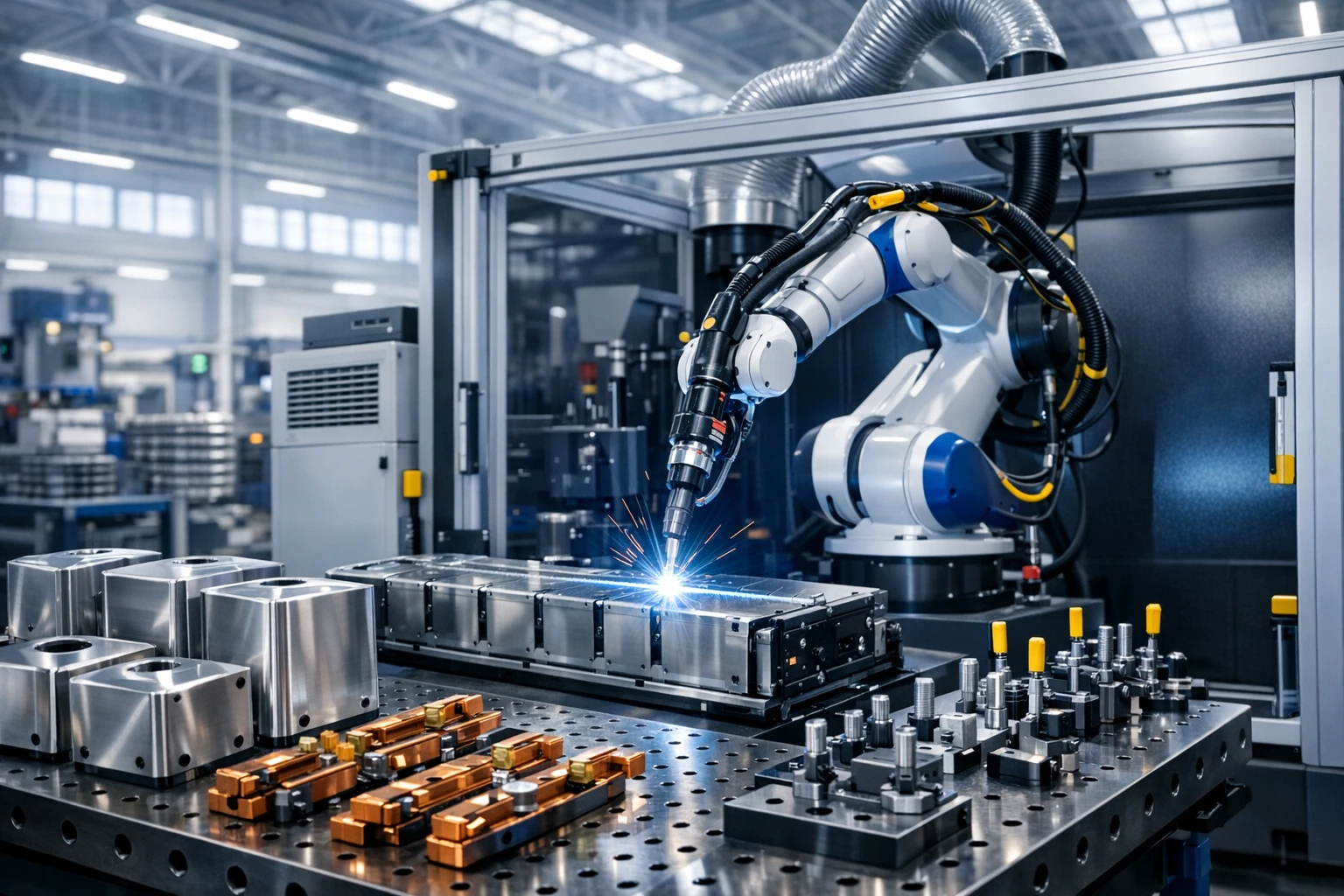
The most visible part of laser welding cost is the equipment itself. Prices vary widely because the term “laser welder” can describe a compact handheld unit, a standalone workstation, or a fully integrated robotic cell with enclosure, vision, fixturing, and in-line inspection. In the current market, lower-cost handheld fiber laser systems may start in the low thousands of dollars, while industrial automated systems can reach well into the tens or hundreds of thousands once integration is complete. The gap between those figures is not marketing theater; it reflects major differences in power, stability, controls, duty cycle, safety, and production capability.
Several equipment-related variables shape that upfront cost:
- Laser source type and power output, often measured in watts or kilowatts
- Beam delivery system, optics, and focusing hardware
- Cooling units, shielding gas equipment, and extraction systems
- Workholding fixtures and part-positioning tools
- Safety enclosure, interlocks, guarding, and compliance features
- Automation elements such as robots, linear stages, seam tracking, or cameras
- Software for programming, monitoring, and data collection
Power level matters because thicker sections and faster travel speeds typically require more energy. A shop welding thin sheet metal may not need the same system as a plant joining structural components or copper-rich electrical parts. Automation also changes the economics dramatically. A manual station may cost less to buy, but a robotic cell can run faster, reduce variability, and support higher output if the job volume is large enough. That is why capital cost should never be judged in isolation from throughput.
Installation brings another layer of spending. Floor space, electrical service, ventilation, gas lines, network connections, and operator training all add to the total. Some businesses also need qualification testing, sample runs, or validation work before production can begin. If the weld is part of a regulated product, documentation and process approval may take time and money that do not appear in the machine brochure. Even simple changes, such as adding a custom fixture to hold parts accurately, can have a noticeable effect on the budget.
Maintenance and depreciation belong in this section too, because ownership cost continues after the first payment. Fiber lasers are often valued for relatively low maintenance compared with some older laser technologies, yet no system is free to operate forever without attention. Optics can become contaminated, nozzles wear, cooling systems need service, and unexpected downtime carries a real cost if production stops. In practical terms, the true equipment expense is not “machine price” alone. It is the combination of purchase, installation, training, maintenance, and the expected working life of the system. That is the foundation on which every later cost calculation is built.
Operating Costs and Job Pricing: What Shapes the Quote on a Real Weld
Once the equipment is in place, the next question becomes more immediate: what makes one laser welding job cheap and another unexpectedly expensive? Here the answer shifts from capital spending to operating cost and application complexity. Shops typically build quotes around machine time, labor, setup, consumables, overhead, and quality requirements. Yet those categories expand or shrink depending on the part. A short weld on a well-designed joint may move through production almost effortlessly. A part with inconsistent fit-up, reflective material behavior, or demanding cosmetic standards can slow the process and push cost upward.
Material is one of the first pricing drivers. Stainless steel is commonly welded by laser with good results, while aluminum and copper can require tighter control because of reflectivity, thermal conductivity, and sensitivity to process variation. Thickness matters too. Thin materials can often be welded at high speed, while thicker sections may need more power, multiple passes, filler material, or alternative techniques. Joint design is equally important. Laser welding generally favors precise fit-up, narrow gaps, and consistent edge preparation. If the parts arrive with variation, the process may need added fixturing, slower travel, or corrective preparation work before the beam ever fires.
Typical job-cost components include:
- Programming and setup time before the first approved part
- Operator or technician labor during production
- Shielding gas consumption and any filler wire used
- Fixture changes, alignment checks, and sample verification
- Inspection time for visual checks, leak testing, or destructive testing
- Rework, scrap, and downtime risk
- Batch size and scheduling efficiency
Volume changes everything. For a one-off repair or a prototype batch, setup can dominate the quote because the fixed preparation cost is spread over only a few pieces. For a high-volume production run, the picture often flips. Once the program is stable and the tooling is proven, fast cycle time can lower the cost per part significantly. This is one reason laser welding is attractive in industries such as automotive, electronics, battery manufacturing, and precision fabrication. A process that is expensive to launch may become highly competitive when repeated thousands of times.
Quality requirements also shape pricing in a quiet but powerful way. If the weld must be airtight, medically clean, visually flawless, or traceable in a production record, more controls are needed. Those can include sample coupons, microscopic inspection, pull tests, monitoring sensors, and documentation. Geography matters as well, since labor rates, energy cost, and shop overhead differ by region. In short, the price of a laser weld is not set by the spark itself. It is formed by the full path from part preparation to final acceptance, and each step can either smooth the journey or add friction to it.
Laser Welding Versus TIG, MIG, and Resistance Welding: Comparing Cost Beyond the Hourly Rate
A common mistake in manufacturing decisions is comparing welding methods only by hourly machine rate. Laser welding often looks expensive through that narrow lens because the equipment cost is usually higher than TIG or MIG, especially for a small shop. However, process selection should be based on total cost of ownership and total cost per acceptable part. That broader view includes travel speed, distortion, post-processing, consumables, rework, fixture complexity, and yield. When those factors are counted, the answer becomes more nuanced than “laser is costly” or “laser is cheaper.” It depends on the application.
TIG welding is often praised for control and weld appearance, and it remains a strong choice for many precision jobs. Its drawback is speed. Manual TIG can be labor-intensive, and the heat input can create distortion that requires straightening or finishing. MIG is generally faster and productive for many fabrication tasks, but it may introduce more spatter and wider heat-affected zones than a well-tuned laser process. Resistance welding can be extremely efficient for specific sheet-metal joints in high volume, though it is limited by access, part geometry, and electrode constraints. Laser welding enters the conversation when manufacturers want a narrow weld, limited heat input, high repeatability, and the ability to automate at scale.
From a cost perspective, laser welding can offer advantages in several areas:
- Higher travel speeds on suitable thin-gauge or precision applications
- Lower distortion, which may reduce straightening or finishing work
- Narrow heat-affected zones that help protect nearby features
- Strong fit with automation, robotics, and digital process monitoring
- Reduced need for filler material in certain joint designs
- Cleaner weld zones with less post-weld cleanup in many cases
Still, there are tradeoffs. Laser welding is less forgiving of gap variation than some conventional methods. If part fit-up is poor, the process window can become narrow and the scrap rate can rise. Highly reflective alloys may require careful parameter development. Thick sections or large gap bridging may favor other techniques. For a low-volume job shop handling mixed work and inconsistent part quality, a conventional process may be the better financial fit. For a high-volume manufacturer making repeat parts with tight tolerances, laser welding may justify its capital cost by delivering speed, stable quality, and lower downstream correction costs.
The best comparison is not a slogan but a worksheet. If laser welding removes two secondary operations, cuts rework, and doubles throughput, its higher machine price may be easy to defend. If the same process demands costly fixtures, extensive training, and tight tolerances that the upstream line cannot maintain, it may become an elegant mismatch. In other words, the most economical weld is not always the one with the lowest visible process cost. It is the one that supports the full production system with the least waste.
Conclusion for Buyers and Fabricators: How to Judge Laser Welding Cost the Smart Way
If you are a buyer, estimator, engineer, or shop manager, the practical lesson is simple: treat laser welding cost as a system-level question, not a single line item. A quote that looks high may include the ingredients needed to deliver repeatability, traceability, and low distortion. A quote that looks low may hide setup risk, limited throughput, or quality problems that surface later. The goal is not to chase the smallest number on paper. The goal is to understand what each number actually buys in productivity, consistency, and risk reduction.
Start with the application itself. Ask what material is being joined, how thick it is, what tolerances the parts can hold, and whether the weld must meet structural, cosmetic, electrical, or sealing requirements. Then consider production volume. If the job is repetitive and quality-sensitive, laser welding often becomes more attractive because setup can be amortized across many parts. If the work is irregular, low-volume, or poorly controlled upstream, the economic case may weaken. That does not make laser welding bad; it simply means the process must fit the real production environment.
When reviewing suppliers or internal capital requests, focus on questions like these:
- What is the expected cost per acceptable part at the planned volume?
- How much setup time is required for new parts or design changes?
- Will laser welding reduce rework, scrap, distortion, or finishing labor?
- What fixtures, safety systems, and training are necessary?
- How stable is the incoming part quality and fit-up?
- What inspection and documentation standards must be met?
- How quickly can the investment be utilized at a productive rate?
It also helps to think in time horizons. In the short term, laser welding can feel like a premium option because of machine cost, integration, and process development. Over the longer term, the balance may shift if the technology supports faster cycles, fewer rejected parts, and lower labor input per weld. That is especially relevant in markets where skilled welding labor is scarce or where part precision makes post-weld correction expensive. Many successful implementations are built on that longer view rather than on first-day economics alone.
For the target audience, the smartest approach is to compare processes with discipline and context. Request sample welds, examine defect rates, measure cycle time honestly, and include setup, maintenance, and inspection in the calculation. Laser welding can be a remarkable tool, but like any tool, its value appears when it is matched to the job it was meant to do. Make the decision with both engineering logic and cost clarity, and the bright beam becomes less of a mystery and more of a measurable business choice.